Particle System manager. More...
#include <ParticleSystem.h>
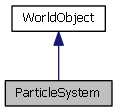
 Inheritance diagram for ParticleSystem:
 Collaboration diagram for ParticleSystem: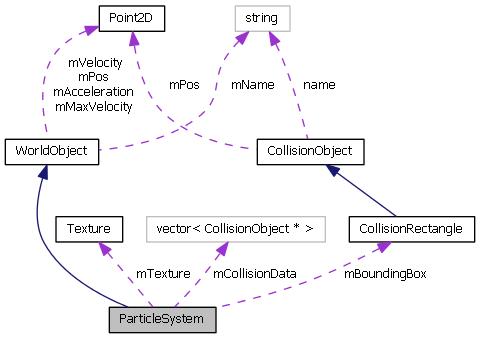
Classes | |
| class | Particle |
| Particle System manager. More... | |
Public Member Functions | |
| ParticleSystem (string name, Point2D position, Texture tex, vector< CollisionObject * > collisionBounds=vector< CollisionObject * >()) | |
| Creates a new particle system with the specified name at the specified position with the specified frame as the animation. More... | |
| ~ParticleSystem () | |
| void | SetTexture (Actor actor, int animation, int frame) |
| Sets a texture to a particle system's particles from a pre-loaded frame already attached to an actor. More... | |
| void | SetTexture (SpriteFrame *frame) |
| Sets a texture to a particle system's particles from a pre-loaded frame. More... | |
| void | SpawnParticles (int numparticles) |
| Spawns a number of new particles into the particle system. More... | |
| virtual void | draw () |
| Draws the thing. More... | |
| virtual void | drawCollisions () |
| Draws collision bounds as well as the ObjectBounds. More... | |
| void | update () |
| This updates the internal particle system's Physics and state (i.e. More... | |
| virtual void | runBehavior () |
| This runs the system's behavior as well as that of the children. More... | |
| vector< Sprite * > | collisionWithSprites (string name, int count=-1) |
| Checks for collision with sprite of a given name. More... | |
| vector< CollisionObject * > & | getCollisionData () |
| Returns collision data. More... | |
| Point2D | getBasePos () |
| Obtain base position. More... | |
| Point2D | getCenterPos () |
| Obtain Center Pos for Collisions. More... | |
| virtual WorldObjectType | getType () |
| This provides a simple interface to determine types of objects. More... | |
| Public Member Functions inherited from WorldObject | |
| WorldObject (std::string name, Point2D pos=Point2D(), int z=0) | |
| void | drawCollisions (vector< CollisionObject * > &vec, const Point2D &pos) |
| Draws CollisionObject data for the Object. More... | |
| void | setPosition (double x, double y) |
| Sets the WorldObject's x an y coordinate. More... | |
| void | setPosition (Point2D pos) |
| Sets the WorldObject's x an y coordinate. More... | |
| void | setBasePosition (double x, double y) |
| Sets the WorldObject's x an y coordinate relative to base pos. More... | |
| void | setBasePosition (Point2D pos) |
| Sets the WorldObject's x an y coordinate relative to base pos. More... | |
| void | setCenterPosition (double x, double y) |
| Sets the WorldObject's x an y coordinate relative to base pos. More... | |
| void | setCenterPosition (Point2D pos) |
| Sets the WorldObject's x an y coordinate relative to base pos. More... | |
| void | move (double dx=0.0, double dy=0.0) |
| Move by given amount NOTE: This is an instantaneous movement by a given amount and does not correspond to physics which is set to do the updated amount per second. More... | |
| virtual void | move (Point2D direction) |
| Moves the WorldObject relative to the current pos. More... | |
| virtual void | moveTowards (Point2D direction) |
| Move towards a given coordinate (path finding) More... | |
| Point2D | getPosition () |
| Gets the WorldObject's position. More... | |
| void | setTransparency (float f) |
| Sets the WorldObject's transparency. More... | |
| float | getTransparency () |
| Gets the WorldObject's transparency. More... | |
| void | setAngle (float a) |
| Sets the WorldObject's angle in degrees. More... | |
| float | getAngle () |
| Gets the WorldObject's angle. More... | |
| void | setVelocity (Point2D vel) |
| Sets the WorldObject's velocity as a vector (will set MaxVelocity if needed) More... | |
| void | setVelocity (double xVel, double yVel) |
| Sets the WorldObject's velocity from coordinates (will set MaxVelocity if needed) More... | |
| Point2D | getVelocity () |
| Gets the WorldObject's Velocity. More... | |
| void | setMaxVelocity (Point2D vel) |
| Sets the WorldObject's MaxVelocity (magnitude) from (x,y) and transforms into a magnitude. More... | |
| void | setMaxVelocity (double vel, Point2D dir) |
| Sets the WorldObject's MaxVelocity (magnitude) value in the direction specified. More... | |
| void | setMaxSpeed (double vel) |
| Sets the WorldObject's MaxVelocity (magnitude) value in the direction specified. More... | |
| Point2D | getMaxVelocity () |
| Gets the WorldObject's Max Velocity. More... | |
| double | getMaxSpeed () |
| Gets the WorldObject's Max Speed. More... | |
| double | getMaxSpeedSquared () |
| Gets the WorldObject's Max Speed Squared (cheaper operation). More... | |
| void | setAcceleration (Point2D accel) |
| Sets the WorldObject's Acceleration in (x,y) coords. More... | |
| Point2D | getAcceleration () |
| Gets the WorldObject's Acceleration. More... | |
| void | setZOrder (int i) |
| int | getZOrder () |
| std::string | getName () |
| returns the WorldObject's name More... | |
| bool | operator< (WorldObject &rhs) |
| Sort worldObjects. More... | |
Public Attributes | |
| Behavior | ParticleInit |
| Sets a behavior function to be run on each particle once when it is spawned. More... | |
| Behavior | ParticleUpdate |
| Sets a behavior function to be run on each particle every game loop. More... | |
| bool | CollisionEnabled |
| Gets or sets whether the particle system has collision checking enabled. More... | |
| int | CollisionList |
| Gets or sets the particle system's collision display list. More... | |
Protected Attributes | |
| list< Particle * > | mParticles |
| Particles this System has generated. More... | |
| CollisionRectangle | mBoundingBox |
| System's collision box for autoCollisions. More... | |
| vector< CollisionObject * > | mCollisionData |
| Collision boundaries provided by user. More... | |
| Texture | mTexture |
| Image to draw. More... | |
| Protected Attributes inherited from WorldObject | |
| std::string | mName |
| WorldObject's name. More... | |
| Point2D | mPos |
| The current (x,y) position. More... | |
| Point2D | mVelocity |
| The current velocity vector. More... | |
| Point2D | mMaxVelocity |
| The max velocity is the max possible velocity where lengthis the speed. More... | |
| double | mMaxSpeed |
| The max Speed if MaxVelocity is 0 to store val. More... | |
| Point2D | mAcceleration |
| The current acceleration vector. More... | |
| bool | mVisible |
| Determine if Object should be visible. More... | |
| float | mTransparency |
| Transparency! More... | |
| float | mAngle |
| Angle of rotation. More... | |
| float | mScale |
| Scale for the sprit. More... | |
| int | ZOrder |
| Stacking order. Determines what draws on top. (subsorted by position) More... | |
| long | mLastUpdate |
| Number that indicates when the Object has last updated. Overflows in about 24 days so no worries. More... | |
| long | mLastDraw |
| Number that indicates when the Object has last updated. Overflows in about 24 days so no worries. More... | |
| bool | mUnused |
| Determines whether or not this object's update function should run. More... | |
| Behavior | mBehavior |
| Behavior to act each loop if !mUnused. More... | |
Additional Inherited Members | |
| Public Types inherited from WorldObject | |
| enum | WorldObjectType { SPRITE, BACKGROUND, MENU, TEXT, PARTICLESYSTEM } |
| This is to be used for Type checking so as to make no need for dynamic_cast and it's inefficiency. More... | |
Detailed Description
Particle System manager.
This class is tasked with the following:
- Spawning Particles
Definition at line 18 of file ParticleSystem.h.
Constructor & Destructor Documentation
| ParticleSystem::ParticleSystem | ( | string | name, |
| Point2D | position, | ||
| Texture | tex, | ||
| vector< CollisionObject * > | collisionBounds = vector<CollisionObject*>() |
||
| ) |
Creates a new particle system with the specified name at the specified position with the specified frame as the animation.
- Parameters
-
name Name to assign to the particle system. position Initial position of the particle system. tex Texture to apply collisionBounds Boundaries for this ParticleSystem
Definition at line 16 of file ParticleSystem.cpp.
Here is the call graph for this function:
| ParticleSystem::~ParticleSystem | ( | ) |
Definition at line 28 of file ParticleSystem.cpp.
Member Function Documentation
| vector< Sprite * > ParticleSystem::collisionWithSprites | ( | string | name, |
| int | count = -1 |
||
| ) |
Checks for collision with sprite of a given name.
- Todo:
- if vals has items in it add each of them into the marked set
Definition at line 180 of file ParticleSystem.cpp.
Here is the call graph for this function: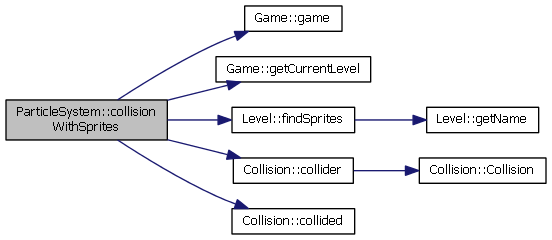
|
virtual |
Draws the thing.
Implements WorldObject.
Definition at line 59 of file ParticleSystem.cpp.
Here is the call graph for this function: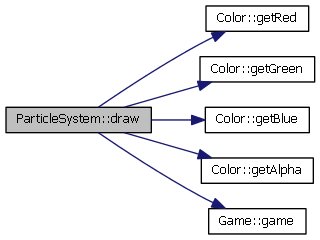
|
virtual |
Draws collision bounds as well as the ObjectBounds.
Reimplemented from WorldObject.
Definition at line 97 of file ParticleSystem.cpp.
Here is the call graph for this function: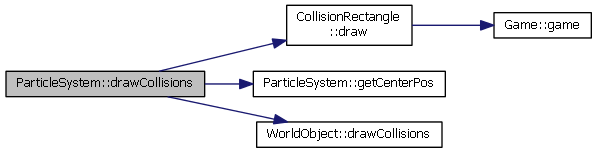
|
virtual |
|
virtual |
Obtain Center Pos for Collisions.
Implements WorldObject.
Definition at line 214 of file ParticleSystem.cpp.
Here is the caller graph for this function:
| vector< CollisionObject * > & ParticleSystem::getCollisionData | ( | ) |
Returns collision data.
Definition at line 176 of file ParticleSystem.cpp.
|
virtual |
This provides a simple interface to determine types of objects.
Returns the name of the Class and Descendants i.e. Something inheriting from Sprite would look like Sprite:Thing
Implements WorldObject.
Definition at line 218 of file ParticleSystem.cpp.
|
virtual |
This runs the system's behavior as well as that of the children.
Reimplemented from WorldObject.
Definition at line 160 of file ParticleSystem.cpp.
Here is the call graph for this function: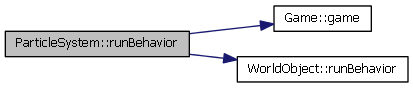
| void ParticleSystem::SetTexture | ( | Actor | actor, |
| int | animation, | ||
| int | frame | ||
| ) |
Sets a texture to a particle system's particles from a pre-loaded frame already attached to an actor.
This function takes a frame from an actor and turns it into the image used for the particles in the system. Particles are drawn as squares and the image is scaled to fit them.
- Parameters
-
actor Actor that owns the animation the target frame belongs to. animation Animation index of the animation that the target frame is part of. frame Index of the target frame in the animation.
Definition at line 32 of file ParticleSystem.cpp.
Here is the caller graph for this function:
| void ParticleSystem::SetTexture | ( | SpriteFrame * | frame | ) |
Sets a texture to a particle system's particles from a pre-loaded frame.
- Parameters
-
frame Frame to load the texture from.
Definition at line 37 of file ParticleSystem.cpp.
| void ParticleSystem::SpawnParticles | ( | int | numparticles | ) |
Spawns a number of new particles into the particle system.
When this function is called, the system's particle initialization function is immediately called on all of the new particles which allows their initial properties to be set immediately.
- Parameters
-
numparticles Number of new particles to spawn.
Definition at line 42 of file ParticleSystem.cpp.
Here is the call graph for this function: Here is the caller graph for this function:
|
virtual |
This updates the internal particle system's Physics and state (i.e.
kills children)
Particle basic Physics update
generate bounding box of this system
Reimplemented from WorldObject.
Definition at line 106 of file ParticleSystem.cpp.
Here is the call graph for this function: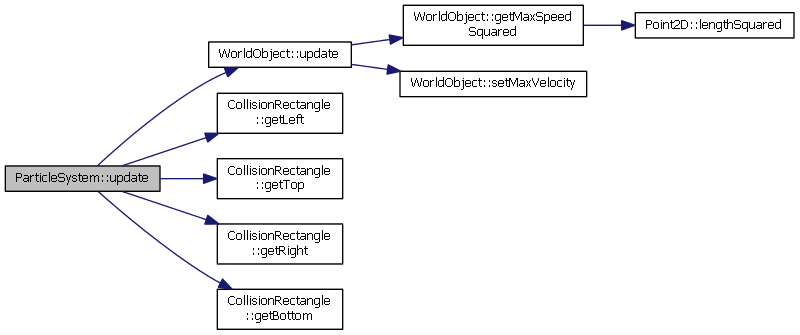
Member Data Documentation
| bool ParticleSystem::CollisionEnabled |
Gets or sets whether the particle system has collision checking enabled.
By default, particle systems have collisions disabled. By calling this function, collisions are enabled, allowing sprites to check for collision with the particle system. Particle systems cannot collide with other particle systems.
Definition at line 149 of file ParticleSystem.h.
| int ParticleSystem::CollisionList |
Gets or sets the particle system's collision display list.
- Todo:
- implement
The display list determines which other objects will not register collisions with the particle system. Sprites will not collide with a particle system with the same display list.
Definition at line 166 of file ParticleSystem.h.
|
protected |
System's collision box for autoCollisions.
Definition at line 260 of file ParticleSystem.h.
|
protected |
Collision boundaries provided by user.
Definition at line 263 of file ParticleSystem.h.
|
protected |
Particles this System has generated.
Definition at line 257 of file ParticleSystem.h.
|
protected |
Image to draw.
Definition at line 266 of file ParticleSystem.h.
| Behavior ParticleSystem::ParticleInit |
Sets a behavior function to be run on each particle once when it is spawned.
Once a particle initialization function is defined, each time SpawnParticles(int) is called, that function is called with
set to the particle that has just been created.
Example of an initialization function:
And here's an example of applying it:
Definition at line 100 of file ParticleSystem.h.
| Behavior ParticleSystem::ParticleUpdate |
Sets a behavior function to be run on each particle every game loop.
The particle update function is called every game loop on every particle in the particle system, setting the current particle to
in every call.
Example of an initialization function:
And here's an example of applying it:
Definition at line 134 of file ParticleSystem.h.
The documentation for this class was generated from the following files: